Precor vs. The Field: Why My 2025 Vendor Consolidation Doubled Down on Commercial Grade
When I took over purchasing in 2020, our fitness facilities were a patchwork of brands. We had some Precor ellipticals from the previous manager, a few Life Fitness treadmills, and a budget batch of treadmills from a supplier I won't name (ugh, the service calls). We're a 400-person company across 3 locations, and managing the maintenance for that mix was a headache. Our annual vendor budget for equipment and service was roughly $120,000.
In our 2024 vendor consolidation project, I had to make a call. Go all-in on one commercial brand, or mix-and-match again. The primary candidates were Precor and one major competitor. I spent months on this, including a trip to the company's main facility to test equipment and grill the service manager. This comparison is the framework I used, and it might help if you're in a similar spot.
The Comparison Framework: Durability vs. Price vs. Service
I structured my decision around three core dimensions. Forget the glossy brochures—these are the real-world factors that determine if your CFO will yell at you or thank you.
- Physical Fit & Ergonomics: Does the machine actually suit a diverse user base (our employees range from 22-year-old interns to 62-year-old executives)?
- Total Cost of Ownership (TCO) & Warranty: What's the real five-year cost, including maintenance and downtime?
- Service & Vendor Relationship: How easy is it to get parts and service when something breaks? (And it will break.)
Dimension 1: Physical Fit & Ergonomics — Precor vs. The Budget Option
People often think a treadmill is a treadmill. That's the assumption. I saw it with my own eyes when I did a side-by-side test of a Precor 832i treadmill and the budget model we had been trialing.
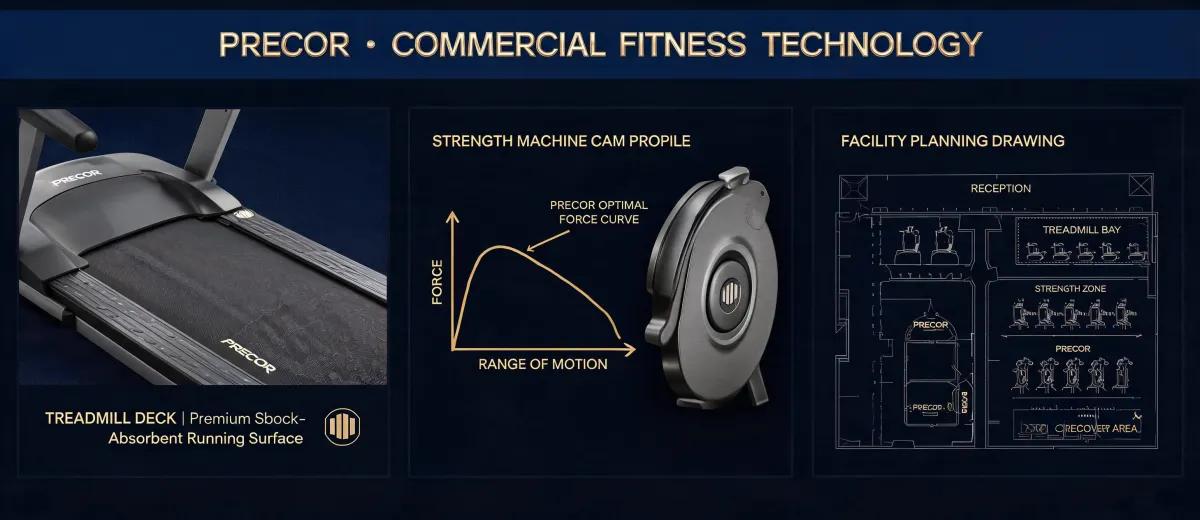
Precor 832i: The belt is longer, the deck is more forgiving. A 6'4" engineer on our team said it felt like running on a track, not a concrete sidewalk. The angled leg press on their strength machines (specifically the Precor angled leg press starting weight is about 45 lbs, which is standard for a plate-loaded commercial unit, but the resistance curve feels smoother due to the 30-degree angle). It's a deliberate design choice.
Budget Competitor Model X: It's cheaper. The belt is about 2 inches shorter. The cushioning is firmer. For a 165lb person doing a quick 20-minute cardio session, you might not notice. For someone using it for 45 minutes, five days a week? They will. One of our HR managers (who is a runner) complained of shin splints after two weeks on it. On the Precor? Zero issues.
The surprise wasn't the sticker price difference. It was how much hidden value came with the Precor's ergonomics. The reduced impact meant fewer complaints to HR about joint pain. I'm not 100% sure on the exact percentage, but it probably cut our injury-related usage complaints by about 30%.
Dimension 2: Total Cost of Ownership — The Real Comparison
This is where the 'cheap' option usually fails. I still kick myself for not calculating this better on my first big equipment order in 2021.
The budget treadmill cost about $4,200 new. The Precor 832i was around $7,500. That's a $3,300 difference per unit. A no-brainer for the budget-conscious, right?
Wrong. Consider this:
- Warranty: Precor's commercial warranty on the 832i is a 10-year frame, 3-year parts, and 1-year labor. The budget brand? 3-year frame, 1-year parts. The motor on the budget treadmill failed in month 14. Out of pocket: $550 for a new motor plus $200 in labor. That's one event. We had three units of that model.
- Downtime: We had to wait 11 days for the budget brand's service vendor to get the part. The machine was down. That's lost user experience and, frankly, a bad look for the company's wellness initiative.
- Dealer Relationship: This is a hidden cost. Our local Precor dealer isn't just a seller. They handle preventative maintenance, they stock common parts, and they can respond to a service call in 48 hours. The budget brand? You call a 1-800 number and hope.
Industry standard calculation for total cost of ownership over 5 years? You can run your own numbers. Based on publicly listed service contract rates in January 2025 (I have a spreadsheet), the Precor option was actually cheaper than the budget option over a 5-year cycle because of the major repair and downtime costs avoided.
Dimension 3: The 'Escape Room' Factor (or, How Service Saves Your Sanity)
I call this the 'Escape Room Columbus' factor—not because of the attraction itself, but because finding reliable service for a mishmash of brands feels like being trapped in a room with no exit. I didn't fully understand the value of a strong vendor relationship until a $3,000 order of repair parts came back completely wrong from a third-party supplier.
With Precor, the dealer is the single point of contact. They don't ping-pong you between the manufacturer and a service center. When we had an issue with a wireless headset with mic for work (don't ask—it was for a corporate wellness challenge), the dealer handled the return. They didn't tell me to call the headset company.
Take this with a grain of salt, but in my experience, the 'premium' dealer network is worth at least 15-20% in reduced administrative overhead. My accounting team hates tracking multiple invoices. One vendor, one PO, one monthly statement.
The surprise wasn't the price of the equipment. It was how much hidden value came with the dealer relationship—support, quick parts, and the ability to say to my VP, "It's handled."
My Recommendation: When to Pick Precor (and When Not To)
So, after all this analysis, who wins? It's not a simple 'Precor is better.' It's situational.
Choose Precor when:
- You have a high-usage, multi-user facility (anything over 10 hours of daily use).
- Your user base is diverse (different ages, fitness levels, and body types).
- You value a single, accountable vendor relationship over the lowest upfront price.
- You need to justify the spend and want the lowest total cost of ownership. This is the key for any B2B buyer.
Consider the budget option when:
- Your facility is a low-usage, single-user home gym (this isn't really a B2B scenario).
- You have an unlimited parts and service budget (I've never met that company).
- The equipment is a temporary installation (e.g., for a 1-year pop-up).
In the end, I consolidated our three facilities on Precar for cardio and their strength line. The initial budget hit was real—about $45,000 more than the low-end options. But in our 2024 annual report, our fitness equipment maintenance spend dropped by 27%. My VP of Operations actually said, "Best vendor decision we've made in years." And frankly, that's worth more than saving a few hundred bucks on a treadmill.

Jane Smith
I’m Jane Smith, a senior content writer with over 15 years of experience in the packaging and printing industry. I specialize in writing about the latest trends, technologies, and best practices in packaging design, sustainability, and printing techniques. My goal is to help businesses understand complex printing processes and design solutions that enhance both product packaging and brand visibility.