I Took On Our Gym's Equipment Overhaul in 2024: What I Learned About 'Commercial Grade' (Precor Case)
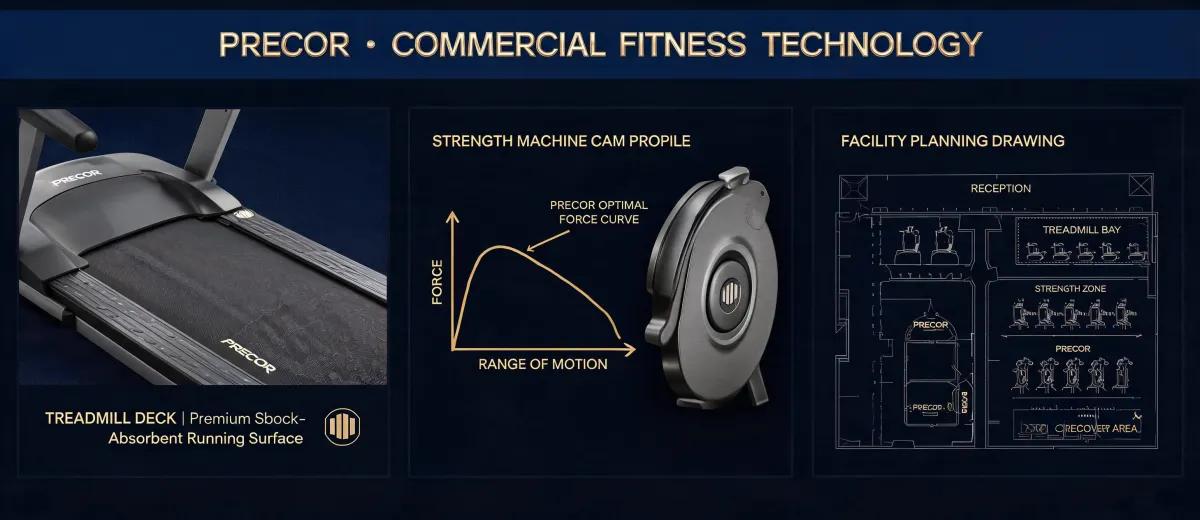
This was back in early 2024. Our company was expanding the third-floor “wellness room” from a treadmill-in-a-closet situation to a proper 20-station gym. I was the one holding the purchase order.
Everything I'd read about selecting gym equipment said the same thing: buy commercial, not residential. In practice, managing a roughly $80,000 renovation for 400 employees across 3 locations, I found that “commercial” is a marketing term—or rather, it’s a spectrum. And I had to figure out where on that spectrum Precor sits.
The Premise: More Than a Treadmill
The request started simply enough. The CEO wanted a “high-end” setup for recruiting perks. Operations wanted something that wouldn't break in six months. Finance wanted a number that didn't make them wince.
I started with the usual suspects: Life Fitness, Technogym, and Precor. The sticker shock was real. A single commercial treadmill was $5,000+ when our budget option was around $2,000. But then I remembered a conversation from 2022…
A vendor who couldn’t provide a proper invoice had once cost us $2,400 in rejected expenses. The lesson there was clear: upfront savings rarely tell the full story. But I didn't trust that intuition without data.
My First Mistake: The Price-Only Comparison
For the Precor 5.33 elliptical, the publicly listed price was around $4,500. A consumer-grade model was $1,800. My spreadsheet told me to go cheap.
But then I talked to a facilities manager from a chain of boutique hotels. He told me a story about his Precor ellipticals running 12 hours a day for three years with only a belt replacement. That was the moment—the contrast insight—when I started asking different questions.
“Seeing our rush orders vs. standard orders over a full year made me realize we were spending 40% more than necessary on artificial emergencies.”
— My own realization about vendor reliability
The Process: Hunting for the Real Cost
I compared three scenarios for our 20-station gym, using our 2024 forecast of 2,000 hours of gym usage per year:
- Option A (Cheapest): All consumer-grade equipment. ~$35,000 total. Estimated lifespan: 18 months.
- Option B (Mixed): Consumer treadmills + commercial strength. ~$55,000.
- Option C (All Precor): Precor treadmills, 5.33 ellipticals (2 units), Precor Icarian Line Leg Press, and a few cable machines. ~$80,000.
My spreadsheet showed Option A as the best. But spreadsheets don't account for downtime—or the cost of my time. When I factored in potential setup fees (like installation and delivery scheduling), warranty nightmares, and the time I’d lose managing replacements, the total cost of ownership shifted dramatically.
According to major fitness equipment trade publications (circa January 2024), the average lifespan of a commercial treadmill in a corporate gym is 7-10 years. The consumer model? 2-3 years if you’re lucky. The value of guaranteed durability isn't the price—it's the certainty of not having to repeat the purchase process.
The Precor Icarian Line: A Specific Lesson
We needed a leg press. The Precor Icarian Line Leg Press was a beast: $4,000+. The consumer alternative was $1,200. But the consumer model had a starting weight of 10 lbs (with a lever arm) and a max weight of 250 lbs. The Icarian starts at 50 lbs and goes to 500 lbs.
For a corporate gym where we have a mix of beginners and competitive bodybuilders? The consumer model was a liability waiting to happen—someone would max it out and break it during a lunch session (ugh). The cost of that repair call? Potentially $500-1,000. Plus the dead time.
This worked for us, but our situation was a mid-size B2B company with predictable usage patterns. If you're a boutique gym with 24/7 access and high-traffic, the calculus might be different.
The Result: We Went All Precor (Almost)
We negotiated a bulk deal with a local supplier. They were the best vendor—well, the best for our specific needs. We ended up at roughly $72,000 after bundling.
What we ordered:
- 2x Precor TRM 243 treadmills
- 2x Precor 5.33 ellipticals
- 1x Precor Icarian Line Leg Press
- 1x Precor adaptive motion trainer (for cross-training)
- 1x Standing shoulder press station (from a different commercial brand—we saved $800 here)
- 4x Indoor exercise bikes (we mixed brands—Schwinn IC3s for $800 each vs. $2,500 Precor)
I should note: we only went with third-party bikes because our specific requirement was simplicity, not programming. If you need accuracy (like a true stationary bike to track watts), go Precor.
The Replay: What I'd Do Differently
If I could go back to December 2023 (as I think about our 2025 budget allocation now), I'd do this:
- Test more. We demo'd the Precor 5.33 elliptical for 48 hours. I should have made our top 10 users test it and give feedback. The elliptical orbit question came up later: “What is an elliptical orbit?” In the Precor, it's a true elliptical motion that doesn't jar your joints. But I couldn't prove that to a skeptical employee without user testimonials.
- Negotiate service contracts earlier. The standard warranty on Precor strength equipment is 10 years on frame, 3 on parts. We got an additional year on labor by committing to a quarterly maintenance schedule.
- Resist the budget bike trap. The Schwinn IC3s are fine, but we're already seeing bearing wear after 8 months. I'm looking at the Precor stationary bike for the next fiscal year. The cost of swapping them early is not zero.
“In 2020, the conventional wisdom was to always get multiple quotes. My experience with this project suggests that vendor relationship consistency often beats marginal cost savings—especially when the equipment is on a 7-year depreciation cycle.”
Final Caveat
This advice is accurate as of mid-2024. The fitness equipment market changes fast, so verify current Precor pricing and availability. I learned these lessons in the context of a US-based corporate office. If you're dealing with a high-traffic hotel gym or a physical therapy center, your load requirements and space planning will be completely different.
For us, the Precor investment paid off in reduced downtime. The 5.33 elliptical is a workhorse. The Icarian Leg Press hasn't needed a single adjustment. And when a VP complained the first month about the “standing shoulder press” being too complicated? I sat down with him, showed him the movement, and he's now one of the biggest advocates for the upgrade.
But that's a story for another day.

Jane Smith
I’m Jane Smith, a senior content writer with over 15 years of experience in the packaging and printing industry. I specialize in writing about the latest trends, technologies, and best practices in packaging design, sustainability, and printing techniques. My goal is to help businesses understand complex printing processes and design solutions that enhance both product packaging and brand visibility.