Precor service planning illustration
Service engineering

Operator Q&A - From specification to post-install performance

Precor service support is written for facilities that cannot afford vague answers. A fitness director needs to understand preventive maintenance, a finance team needs to model refresh timing, and a maintenance lead needs to know exactly which wear parts matter before the first unit arrives.

The service program begins with an equipment audit and a layout review. We document expected daily use, cleaning protocol, electrical and network assumptions, and the operational consequence of downtime. That lets each facility choose between a standard maintenance cadence, a higher-touch service plan for premium clubs, or a rollout program for multi-location operators.

01

Pre-install support

Before a purchase order is released, Precor reviews floor area, member traffic assumptions, ceiling and access clearances, power placement, delivery route, and the expected balance between cardio and strength. The output is a practical service file rather than a sales deck: product families, footprint notes, utility assumptions, and questions the facility team should resolve with construction or operations.

  • Facility survey with traffic and queue assumptions
  • Model comparison for treadmills, ellipticals, bikes, and strength stations
  • Install sequencing for clubs that remain open during renovation
02

Post-install operations

After installation, the service conversation moves to uptime evidence. Operators receive routines for belt checks, console inspection, cable and upholstery review, safety signage, and staff escalation. Multi-site facilities can standardize ticket language so a treadmill fault, elliptical noise, or selectorized cable issue is reported with enough detail for fast triage.

  • Preventive maintenance calendar by equipment family
  • Technician handoff notes and operator training sessions
  • Lifecycle review that feeds capital refresh planning
Common service questions

Eight questions worth answering before equipment ships

How often should commercial cardio be inspected?

High-traffic clubs typically review belt tracking, deck condition, console response, and cleaning impact weekly, with deeper preventive maintenance scheduled by usage hours and service contract terms.

What information helps a technician triage faster?

Model name, serial number, error code, observed behavior, room conditions, cleaning product exposure, and recent service history reduce guesswork and shorten the first diagnostic call.

Can strength equipment be planned for coach-led programs?

Yes. Resistance path, seat adjustment range, cable routing, and user flow should be reviewed with strength coaches before the room is frozen.

How should hotels think about service?

Hotel gyms need quiet operation, simple guest instructions, compact spare-part planning, and a response process that respects room occupancy and brand standards.

What belongs in a five-year ownership model?

Acquisition cost, install, service visits, wear-part assumptions, staff training, downtime exposure, and refresh timing should be in one model.

Does networked equipment change maintenance?

Networked consoles add firmware, connectivity, privacy, and content update workflows. These should be assigned to an owner before go-live.

When should a facility refresh equipment?

Refresh timing should be based on utilization, repair history, member experience, parts availability, and capital planning rather than age alone.

How do multi-site operators standardize support?

Use shared issue categories, serial-number discipline, training templates, and recurring utilization reviews across locations.
Before service mapping

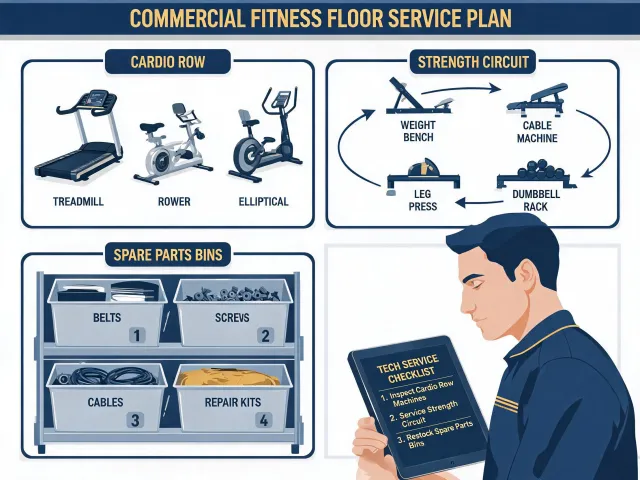
A club buys equipment by model preference alone. The install team discovers tight access to the cardio row, service tickets arrive with incomplete descriptions, and finance cannot separate real wear from avoidable downtime. Staff members respond case by case because the maintenance routine is undocumented.

After service mapping

The same club receives a zone-by-zone service file, a preventive calendar, a ticket template, and a refresh forecast. Trainers know which stations support their programs, maintenance knows which components need inspection, and finance sees how service assumptions affect total cost of ownership.

Send the equipment list before the room is locked

Precor can review your planned floor, identify service access risks, and return a structured question list for procurement, construction, and operations.